
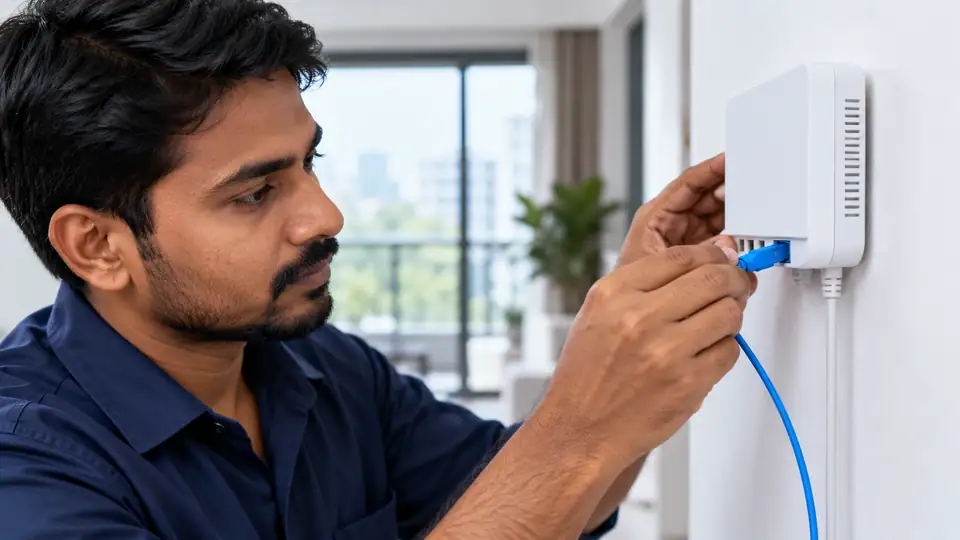
List the fixed devices that need a wired connection and discuss ports and cable routes before ordering equipment. Check the capabilities of the device, adapter and router as a complete path. A subscribed speed tier does not guarantee that an older local link can carry that rate.
Before the visit, describe the intended cable path and any areas that require permission. Shared corridors, terraces, shafts and rented interiors can involve different access arrangements. Resolve those practical questions alongside the booking so the technician can assess a usable route.
Make the installation brief address-specific
Check the power point and the space for the supplied equipment. Avoid deciding the router position only after the fibre has been fixed. The installation should support the rooms and devices you intend to use, with any additional cabling discussed in advance.
Agree how work outside the standard scope will be handled. This may include an alternative route, added equipment or finishing work that is not part of ordinary cable fixing. A clear explanation and approval should come before an unexpected additional charge.
Treat the indoor network as a separate system
Mark the places where the connection must be useful: desks, televisions and other fixed or frequently used devices. Test those points with consistent equipment. A good result beside the router is a starting reference rather than a complete room-coverage assessment.
Keep router placement separate from the optical entry decision. If the best wireless position is elsewhere, ask what cabling or equipment arrangement is practical. Do not hide the router in a closed cabinet merely to keep it beside the incoming fibre.
Request a connection with a clear room-coverage brief
- Decision context
When a distant room is weak, compare an alternative router position before purchasing equipment. Use the same device and task for each trial. If the problem remains, discuss a planned access point or mesh arrangement and how it will connect back to the main network.
- Evidence to collect
For more than one floor, assess each working level independently. A strong connection on one floor does not establish the result through a slab or stairwell. The proposed network should be tested at the actual use points, not accepted only on a coverage claim.
Verify a home connection on the devices that matter
- Decision context
Begin with a simple baseline: note the device, time, connection method and whether other heavy transfers are active. Repeat the important task under the same conditions before changing anything. Consistent observations are more useful than a collection of unrelated speed figures.
- Evidence to collect
Where suitable fixed devices support Ethernet, discuss a wired path. It can remove the wireless hop from troubleshooting and reserve Wi-Fi for devices that need mobility. It does not change the subscribed bandwidth or eliminate limits elsewhere in the connection.
Prepare the rooms for a home WiFi installation
- Decision context
Check the band and device capability during a wireless comparison. A result from one phone or band may not describe an older laptop or a television in a different position. Keep the test conditions with the result so later comparisons are meaningful.
- Evidence to collect
Wi-Fi is the last part of the connection between the router and a device. A healthy fibre service can still feel slow if that wireless path is weak or congested. Compare a result close to the router with the room where the problem occurs before judging the incoming line.
Confirm access permissions before a short-notice visit
- Decision context
Make sure an authorised person can attend the visit and provide the necessary access. Give the installer a reachable contact and mention any time restrictions. The appointment is more useful when both the proposed route and the intended equipment location can be reviewed on site.
- Evidence to collect
At activation, identify the equipment supplied and keep the handover record. Confirm how to reach support and what to do if the connection does not work as expected after the technician leaves. Also retain any ownership or refundable-security conditions.
Track a PIN-code enquiry from request to activation
- Decision context
Request a quotation that shows the service period, subscription, applicable taxes and any equipment or installation payment separately. This is the clearest way to understand what is due now and what will recur later. Confirm the final amount before treating a displayed monthly price as a complete order.
- Evidence to collect
For Freedom Fighter Enclave, give the exact building or house number, unit, floor and a useful landmark. Include a map pin if requested, but keep the written address with it. These details help the team review the actual premises instead of making an assumption from the locality name.
Make a same-day request with realistic checkpoints
- Decision context
If you need internet quickly, state the date and the task that depends on it when you enquire. Then ask what still needs to happen: address verification, route approval, equipment allocation or an installation slot. A requested same-day connection is not a confirmed appointment.
- Evidence to collect
Reduce avoidable delays by supplying a complete address, floor, map pin and an available contact person. Check whether access permission is needed and whether that person can admit the technician to the relevant areas. Have the intended equipment position and power point ready for discussion.
Build a room-to-room WiFi acceptance sheet
- Decision context
If practical, test with a capable device over Ethernet and compare it with the normal Wi-Fi position. A difference between the two helps identify the part of the connection worth examining next. One result alone does not prove a fault in the provider's line.
- Evidence to collect
Repeat the task that originally caused difficulty. A successful speed test does not by itself confirm that a work VPN, game or video meeting behaves correctly. Record which applications work and which fail so the next investigation stays focused.
Ask who owns an unresolved support request
- Decision context
Contact Fiber Internet on 9990881098 with the account reference or exact installation address and a concise description of the issue. Include when it began and whether it affects one device, one room or the whole connection. Those facts help determine the next check.
- Evidence to collect
Describe equipment lights as you see them rather than assigning a cause from memory. If support requests a restart, follow the normal equipment procedure. Do not factory-reset the router or disturb fibre connectors unless the responsible technician explicitly guides that action.
Choose home internet around everyday activities
- Decision context
Make a short list of activities that are genuinely active together. Live calls, streams, large transfers and cloud synchronisation affect demand differently from devices that are simply connected. Use the busiest normal period as the basis for the discussion.
- Evidence to collect
Include upload-heavy work in the brief. Sending video, backing up files and remote camera access may matter even when ordinary browsing is comfortable. Ask how the proposed service fits those tasks instead of evaluating it solely by its download headline.
Plan Ethernet between floors before choosing mesh
- Decision context
Keep the router in an open, reasonably central position where practical. Metal enclosures, crowded electronics and an awkward corner can work against coverage. Test a proposed position with the same device before making cable fixing or furniture placement permanent.
- Evidence to collect
The 2.4 GHz and 5 GHz bands have different strengths and limitations, and results depend on the surroundings and equipment. The phrase 5G router on a broadband offer often refers to dual-band Wi-Fi here, not a mobile-data subscription. Confirm the actual device and features supplied.
Onboard smart devices without weakening the whole network
- Decision context
Smart-home devices can have different networking requirements from a laptop or television. Check the manufacturer's supported Wi-Fi bands and setup instructions for each device. A phone connected successfully on one band does not prove that a sensor or appliance can join the same configuration.
- Evidence to collect
Plan coverage where the devices are installed, including awkward corners or utility spaces. Do not judge the whole setup from the main living area alone. If a device disconnects repeatedly, note whether nearby devices are affected and whether its power supply remains stable.
Get permission before routing fiber through a rented home
- Decision context
Check the practical result before declaring the installation complete. Try the important rooms and an appropriate wired device where available. Record any unresolved coverage issue so its proposed remedy is agreed rather than assumed to be included automatically.
- Evidence to collect
An installation booking should start with a route the technician can assess. Supply the building or house number, floor, entry restrictions and a reliable landmark. A map pin is useful alongside those details, but it does not describe how a cable can safely reach the intended room.
Reduce WiFi contention in a shared living room
- Decision context
A speed upgrade does not make walls or floors disappear. When the problem is confined to a distant room, examine router position, the device's connection and the need for a better local network path. Choose additional equipment after those checks rather than assuming any repeater will solve the issue.
- Evidence to collect
Start a mesh enquiry with a simple map of the rooms that need coverage. Mark the router, the available power points and the places where service is unreliable. The objective is a workable connection in those rooms, not the largest number of nodes or the most impressive coverage claim.
Write a permission brief for a rental installation
- Decision context
Decide where the fibre will terminate and where the router should operate. Those positions need not be identical, and the most convenient cable entry is not always the best place for Wi-Fi. Discuss the cable path, power supply and any additional networking work before the visit.
- Evidence to collect
Arrange permission for access to shared passages, shafts or terraces if the proposed route needs them. Clarify responsibility for drilling, concealed wiring and work outside the standard installation scope. The installer should be able to explain any additional charge before that work begins.
Separate visiting phones from smart-home controls
- Decision context
Keep ownership of the router and device-management accounts clear. Use supported security settings and maintain equipment according to the manufacturer's guidance. Avoid sharing administration passwords merely to let someone use the broadband connection.
- Evidence to collect
Treat remote app access and local device connectivity as separate checks. A cloud service or account problem can prevent control even when the home network works. Record the app message and test other services before changing the entire network.
Agree shared-home rules for large transfers
- Decision context
A shared-home connection should be planned for the busiest overlap, not just the number of residents. Ask when people attend classes, join calls, stream or upload large files. Agree which activities cannot easily be moved to a quieter time before selecting the package.
- Evidence to collect
Decide who manages the subscription and how residents report a problem. Shared payment arrangements should make the renewal date and agreed contribution clear. A named account owner and a simple contact process help prevent billing questions from becoming unexplained service interruptions.
Compare a fiber provider's installation handover
- Decision context
Try another suitable device when the problem seems confined to one laptop, phone or television. Keep the location and network method comparable. If the second device behaves differently, examine device or application settings before altering the entire household network.
- Evidence to collect
When testing at different times, keep a short record rather than relying on memory. Note what other household activity was running and whether the equipment lights changed. This helps distinguish a recurring pattern from a single slow response at a remote service.
Apply these checks to the exact premises
Ask for confirmation that the proposed address can be served through an approved route. A nearby connection is useful context, but it is not a guarantee for another floor or building. Wait for the property-specific response before relying on an installation date.
Mention access restrictions early, including locked common areas or permissions required from an owner or manager. State who can approve the work and who can attend the visit. The team can then identify the next practical step instead of booking around missing information. Related information: 9990881098 9990881098 published plan information request an address check
Published Fiber Internet plan options
Ask whether the displayed figure is the normal renewal rate or part of an offer. If an introductory benefit applies, record its duration and eligibility conditions. Keep the written quote so a later renewal can be compared with what was agreed at the start. Related information: broadband plans page
| Plan | Speed | Monthly price | Included benefits | Availability |
|---|---|---|---|---|
| Fiber Start | 100 Mbps | ₹499/month | Unlimited data, free installation, 24×7 customer support | Enquire |
| Fiber Plus | 200 Mbps | ₹699/month | Unlimited data, free installation, 24×7 priority support | Enquire |
| Fiber Pro | 300 Mbps | ₹799/month | Unlimited data, free installation, 24×7 priority support | Enquire |
| Fiber Ultra | 500 Mbps | ₹1,699/month | Unlimited data, free installation, 24×7 priority support | Enquire |
Record which devices are supplied by the provider and which belong to you. Support and replacement responsibility can differ between an optical terminal, router and added access point. Agree those boundaries before purchasing or replacing equipment.
The website publishes monthly reference prices of ₹499 for 100 Mbps, ₹699 for 200 Mbps, ₹799 for 300 Mbps and ₹1,699 for 500 Mbps. Confirm the current order terms, billing period and any additional payable items with Fiber Internet before making payment. Related information: Call 9990881098 for a custom quote