
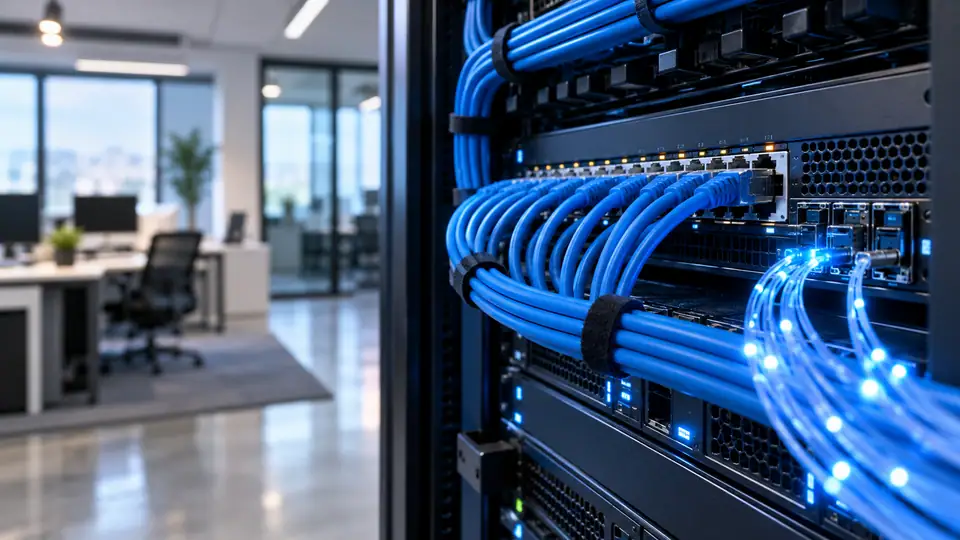
A shop's broadband brief should distinguish operational devices from customer use. List billing terminals, stock applications, cameras and any guest Wi-Fi. Explain which tasks must continue during the busiest trading period so the connection and local network can be planned around them.
Before the visit, describe the intended cable path and any areas that require permission. Shared corridors, terraces, shafts and rented interiors can involve different access arrangements. Resolve those practical questions alongside the booking so the technician can assess a usable route.
Separate internet service from business continuity
Start with the business processes that depend on connectivity: billing, calls, cloud applications, cameras or customer access. Identify which must keep working together and which can wait. This gives the provider a concrete service brief rather than a generic request for office Wi-Fi.
Plan fixed desks and devices separately from guest access. A suitable wired path can simplify troubleshooting for important equipment, while a guest network can separate visitor use where the equipment supports it. Agree who will manage the router and maintain access credentials.
Make the installation brief address-specific
Check the power point and the space for the supplied equipment. Avoid deciding the router position only after the fibre has been fixed. The installation should support the rooms and devices you intend to use, with any additional cabling discussed in advance.
Agree how work outside the standard scope will be handled. This may include an alternative route, added equipment or finishing work that is not part of ordinary cable fixing. A clear explanation and approval should come before an unexpected additional charge.
Plan clinic appointment access during a network fault
- Decision context
Contact Fiber Internet on 9990881098 with the account reference or exact installation address and a concise description of the issue. Include when it began and whether it affects one device, one room or the whole connection. Those facts help determine the next check.
- Evidence to collect
Describe equipment lights as you see them rather than assigning a cause from memory. If support requests a restart, follow the normal equipment procedure. Do not factory-reset the router or disturb fibre connectors unless the responsible technician explicitly guides that action.
Coordinate agency asset delivery and client meetings
- Decision context
A video call needs a steady two-way path, not simply a fast download. Describe whether the problem is frozen video, delayed speech, disconnection or one participant's audio. Those distinctions help separate the local network from the device, application and other participant's connection.
- Evidence to collect
Test a call near the router or on a suitable wired connection, then repeat from the usual desk. Pause large uploads and backups for the comparison. Keep the same device and application so you change only one part of the setup at a time.
Keep clinic guest WiFi away from practice systems
- Decision context
Place network equipment where it can be maintained without obstructing staff or being easily disturbed by customers. Consider the counter, storage area and other working locations when testing coverage. A speed test at the entrance alone does not establish that the billing position has a reliable path.
- Evidence to collect
Keep guest access separate from operational devices where the network equipment supports it. Agree who manages access details and how changes are documented. If a payment application fails while other internet services work, follow that application's support process as well as recording the connection symptoms.
Put clinic network ownership into the handover
- Decision context
Begin with a simple baseline: note the device, time, connection method and whether other heavy transfers are active. Repeat the important task under the same conditions before changing anything. Consistent observations are more useful than a collection of unrelated speed figures.
- Evidence to collect
If practical, test with a capable device over Ethernet and compare it with the normal Wi-Fi position. A difference between the two helps identify the part of the connection worth examining next. One result alone does not prove a fault in the provider's line.
Set a fair guest-WiFi policy for a cafe
- Decision context
Plan a fallback for the specific tasks the business considers essential. Test it with the relevant device and account before relying on it during an interruption. A backup that cannot reach the required application may not solve the trading problem even if it provides general internet access.
- Evidence to collect
Make a short list of activities that are genuinely active together. Live calls, streams, large transfers and cloud synchronisation affect demand differently from devices that are simply connected. Use the busiest normal period as the basis for the discussion.
Choose a startup connection around its critical application
- Decision context
Include upload-heavy work in the brief. Sending video, backing up files and remote camera access may matter even when ordinary browsing is comfortable. Ask how the proposed service fits those tasks instead of evaluating it solely by its download headline.
- Evidence to collect
Identify the rooms and devices that must work reliably at specific times. A household may prefer dependable connectivity at two work desks over impressive results beside the router. The local network arrangement should reflect those priorities.
Prioritise interactive office traffic during large transfers
- Decision context
Read support and commercial terms alongside bandwidth. Ask how a fault is logged, what information the provider needs and which response commitments are actually included. If the business requires contractual service levels or special network features, request an appropriate quotation rather than assuming a residential plan includes them.
- Evidence to collect
Keep the network understandable for the people responsible for it. Record the equipment, cabling, account reference and escalation contact without circulating passwords unnecessarily. If an outage would stop trading, discuss a tested fallback and the separate power requirements.
Keep staff devices separate from visitor WiFi
- Decision context
Compare what happens when competing transfers stop. If the essential task improves, shared capacity or local traffic management may be relevant. If the same single room remains weak, investigate its wireless path before paying for more incoming bandwidth.
- Evidence to collect
Ask for the complaint reference and what happens next. Keep the time of the report, the tests already performed and any promised update together. If the symptom changes, add that new observation instead of starting the description again from scratch.
Restart equipment without erasing its configuration
- Decision context
Record which devices are supplied by the provider and which belong to you. Support and replacement responsibility can differ between an optical terminal, router and added access point. Agree those boundaries before purchasing or replacing equipment.
- Evidence to collect
Ask for the model and features of the proposed router. Confirm its compatibility with the service and the devices that will use it. Terms such as dual-band or high-speed are useful only when the actual equipment and intended setup are understood.
Write an office handover checklist for the installer
- Decision context
Repeat the task that originally caused difficulty. A successful speed test does not by itself confirm that a work VPN, game or video meeting behaves correctly. Record which applications work and which fail so the next investigation stays focused.
- Evidence to collect
Try another suitable device when the problem seems confined to one laptop, phone or television. Keep the location and network method comparable. If the second device behaves differently, examine device or application settings before altering the entire household network.
Prepare the rooms for a home WiFi installation
- Decision context
Mark the places where the connection must be useful: desks, televisions and other fixed or frequently used devices. Test those points with consistent equipment. A good result beside the router is a starting reference rather than a complete room-coverage assessment.
- Evidence to collect
Keep router placement separate from the optical entry decision. If the best wireless position is elsewhere, ask what cabling or equipment arrangement is practical. Do not hide the router in a closed cabinet merely to keep it beside the incoming fibre.
Prepare a concise ISP contact message
- Decision context
Separate a service enquiry from a device-repair request. Explain whether you need a new connection, coverage assistance or diagnosis of particular hardware. That makes it easier to agree the scope and any applicable charge before work begins.
- Evidence to collect
When escalating a recurring problem, provide a short sequence of incidents with comparable observations. Mention any wired result and whether all services failed together. A clear history gives the next technician more to work with than an unsupported conclusion that the plan is too slow.
Ask what happens if installation proves infeasible
- Decision context
Make sure an authorised person can attend the visit and provide the necessary access. Give the installer a reachable contact and mention any time restrictions. The appointment is more useful when both the proposed route and the intended equipment location can be reviewed on site.
- Evidence to collect
At activation, identify the equipment supplied and keep the handover record. Confirm how to reach support and what to do if the connection does not work as expected after the technician leaves. Also retain any ownership or refundable-security conditions.
Prepare for activation after the physical cable is fitted
- Decision context
Check the practical result before declaring the installation complete. Try the important rooms and an appropriate wired device where available. Record any unresolved coverage issue so its proposed remedy is agreed rather than assumed to be included automatically.
- Evidence to collect
When a distant room is weak, compare an alternative router position before purchasing equipment. Use the same device and task for each trial. If the problem remains, discuss a planned access point or mesh arrangement and how it will connect back to the main network.
Resolve installation WiFi issues before adding equipment
- Decision context
An installation booking should start with a route the technician can assess. Supply the building or house number, floor, entry restrictions and a reliable landmark. A map pin is useful alongside those details, but it does not describe how a cable can safely reach the intended room.
- Evidence to collect
Decide where the fibre will terminate and where the router should operate. Those positions need not be identical, and the most convenient cable entry is not always the best place for Wi-Fi. Discuss the cable path, power supply and any additional networking work before the visit.
Put the work desk on the network plan before installation
- Decision context
Arrange permission for access to shared passages, shafts or terraces if the proposed route needs them. Clarify responsibility for drilling, concealed wiring and work outside the standard installation scope. The installer should be able to explain any additional charge before that work begins.
- Evidence to collect
At handover, check that the account is active, the equipment is identified and the intended devices can connect. Test the important rooms as well as a point close to the router. Keep the payment record and support contact with any equipment-return conditions.
Confirm building-specific installation costs before payment
- Decision context
Request a quotation that shows the service period, subscription, applicable taxes and any equipment or installation payment separately. This is the clearest way to understand what is due now and what will recur later. Confirm the final amount before treating a displayed monthly price as a complete order.
- Evidence to collect
Ask whether the displayed figure is the normal renewal rate or part of an offer. If an introductory benefit applies, record its duration and eligibility conditions. Keep the written quote so a later renewal can be compared with what was agreed at the start.
Apply these checks to the exact premises
For Westend Marg, give the exact building or house number, unit, floor and a useful landmark. Include a map pin if requested, but keep the written address with it. These details help the team review the actual premises instead of making an assumption from the locality name.
Ask for confirmation that the proposed address can be served through an approved route. A nearby connection is useful context, but it is not a guarantee for another floor or building. Wait for the property-specific response before relying on an installation date. Related information: 9990881098 9990881098 published plan information request an address check
Published Fiber Internet plan options
The website publishes monthly reference prices of ₹499 for 100 Mbps, ₹699 for 200 Mbps, ₹799 for 300 Mbps and ₹1,699 for 500 Mbps. Confirm the current order terms, billing period and any additional payable items with Fiber Internet before making payment. Related information: broadband plans page
| Plan | Speed | Monthly price | Included benefits | Availability |
|---|---|---|---|---|
| Fiber Start | 100 Mbps | ₹499/month | Unlimited data, free installation, 24×7 customer support | Enquire |
| Fiber Plus | 200 Mbps | ₹699/month | Unlimited data, free installation, 24×7 priority support | Enquire |
| Fiber Pro | 300 Mbps | ₹799/month | Unlimited data, free installation, 24×7 priority support | Enquire |
| Fiber Ultra | 500 Mbps | ₹1,699/month | Unlimited data, free installation, 24×7 priority support | Enquire |
Keep equipment payments separate from the service subscription. Where refundable security applies, retain the amount, return conditions and acknowledgement process. The end of the broadband account and the return of hardware may require separate steps.
Refundable equipment security belongs on a separate line from non-refundable service charges. Ask what equipment the security covers, which return conditions apply and how the refund is processed. A receipt is useful only when the purpose of the payment is clear. Related information: Call 9990881098 for a custom quote